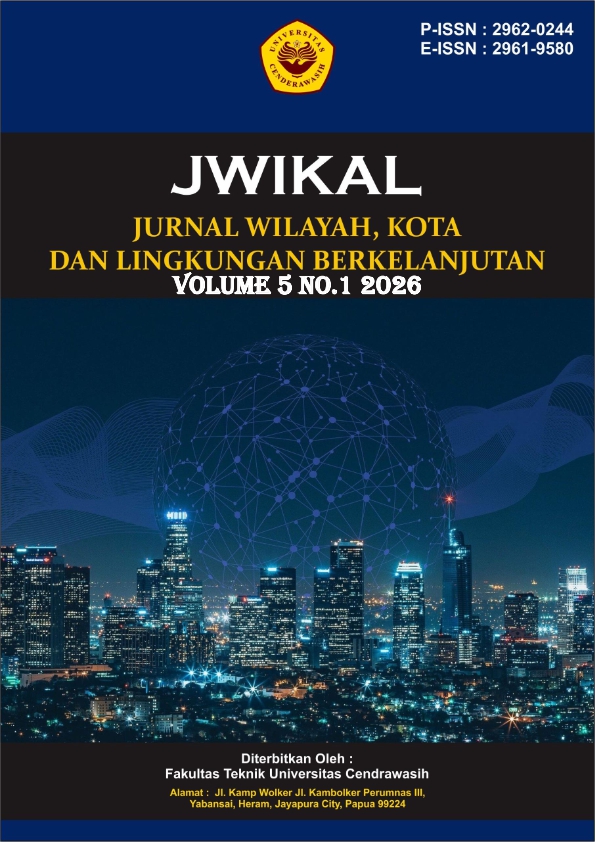
Evaluasi Kinerja Saluran pada Sistem Drainase Kawasan UPN “Veteran” Jawa Timur
DOI:
https://doi.org/10.58169/jwikal.v5i1.1110Keywords:
Channel Capacity, Drainage, Hydraulics, Hydrology, Stormwater RunoffAbstract
The drainage system is critical infrastructure for managing stormwater runoff in densely built urban areas, including higher education institutions. This study aims to evaluate the capacity performance of the existing drainage channels in the UPN "Veteran" Jawa Timur campus area. The evaluation was conducted through two main stages: hydrological analysis using the rational method to estimate the design runoff discharge for a 10-year return period, and hydraulic analysis using Manning's equation to calculate the channel cross-sectional capacity in accordance with Permen PU No. 12 of 2014. Based on the assessment of 43 drainage channels, the results showed that 33 channels (76.7%) are still functioning optimally and capable of accommodating the design discharge. Conversely, 10 channels (23.3%) were identified as having insufficient capacity. This capacity deficit was triggered by initial designs that did not accommodate the 10-year return period flood discharge, increased runoff coefficients due to massive pavement development, and effective cross-section narrowing caused by sedimentation. To mitigate inundation issues, this study recommends redesigning the failing channels using an economical hydraulic cross-section, accompanied by periodic normalization and dredging for functional channels. The findings of this study are expected to serve as technical guidelines for the optimal and sustainable management of campus drainage infrastructure.
References
Arfiansyah, I., Andawayanti, U., & Prasetyorini, L. (2024). Studi evaluasi saluran drainase di Desa Kuang, Kecamatan Taliwang, Sumbawa Barat. Jurnal Teknologi dan Rekayasa Sumber Daya Air, 4, 664–677. https://doi.org/10.21776/ub.jtresda.2024.004.01.057
Arifin, M. (2018). Evaluasi kinerja sistem drainase perkotaan di wilayah Purwokerto. Jurnal Teknik Sipil-UCY.
Asdak, C. (2010). Hidrologi dan pengelolaan daerah aliran sungai. Gadjah Mada University Press.
Ifanda, N. (2024). Evaluasi sistem saluran drainase dengan software HEC-RAS: Studi kasus Jalan Raya Mayjend Sungkono, Surabaya. Teknik Lingkungan, UPN Veteran Jawa Timur. https://doi.org/10.30736/jev.v8i2.759
Kementerian Pekerjaan Umum. (2014). Peraturan Menteri Pekerjaan Umum Republik Indonesia Nomor 12/PRT/M/2014 tentang penyelenggaraan sistem drainase perkotaan. Kementerian Pekerjaan Umum.
Mahendra, G. (2020). Analisis hujan rencana tahunan metode Gumbel. Konservasi DAS. https://konservasidas.fkt.ugm.ac.id/2020/12/14/analisi-hujan-rencana-tahunan-metode-gumbel/
Meylani, V., dkk. (2021). Analisis sistem saluran drainase pada Perumahan Baturaja Permai di Kota Baturaja Kabupaten Ogan Komering Ulu. Jurnal Deformasi, 6(1), 15–22. https://doi.org/10.31851/deformasi.v5i1.4233
Moduti, R. (2011). Manajemen sistem drainase perkotaan. Penerbit Universitas Indonesia.
Pradnyani, N. K. A., dkk. (2026). Evaluasi kapasitas saluran drainase menggunakan simulasi HEC-RAS. Jurnal Teknik Gradien. https://ojs.unr.ac.id/index.php/teknikgradien/article/view/1702
Rizandy, M. N. (2024). Analisis pengaruh perubahan tata guna lahan terhadap debit limpasan drainase Kecamatan Depok, Sleman. Fakultas Teknik Sipil dan Perencanaan, Universitas Islam Indonesia.
Setiawan, I. (2020). Evaluasi kapasitas saluran drainase di Jalan Pramuka [Tugas akhir, Universitas Islam Indonesia].
Soemarto, C. D. (1999). Hidrologi teknik. Erlangga.
Suripin. (2004). Sistem drainase perkotaan yang berkelanjutan. Andi Offset.
Suryaman, H. (2013). Evaluasi sistem drainase Kecamatan Ponorogo Kabupaten Ponorogo. Jurnal Penelitian, 2(1), 0–7.
Tamimi, R., Wahyuni, R., & Hidayah, E. (2016). Kajian evaluasi sistem drainase Jalan Srikoyo Kecamatan Patrang Kabupaten Jember. Jurnal Rekayasa Sipil dan Lingkungan, 1(1), 18. https://doi.org/10.19184/jrsl.v1i01.3741
Taufik, M., Setiawan, A., & Prasetiyo, I. (2020). Analisis sistem drainase untuk mengatasi banjir. Surya Beton: Jurnal Ilmu Teknik Sipil, 4(2), 17–24. https://doi.org/10.37729/suryabeton.v4i2.992
Downloads
Published
How to Cite
Issue
Section
License
Copyright (c) 2026 JURNAL WILAYAH, KOTA DAN LINGKUNGAN BERKELANJUTAN

This work is licensed under a Creative Commons Attribution-ShareAlike 4.0 International License.